Anthropic and OpenAI Models Absorb Agent Harnesses
As advanced models from Anthropic and OpenAI absorb their external scaffolding, the role of the AI engineer is shifting from building agent loops to managing human attention.
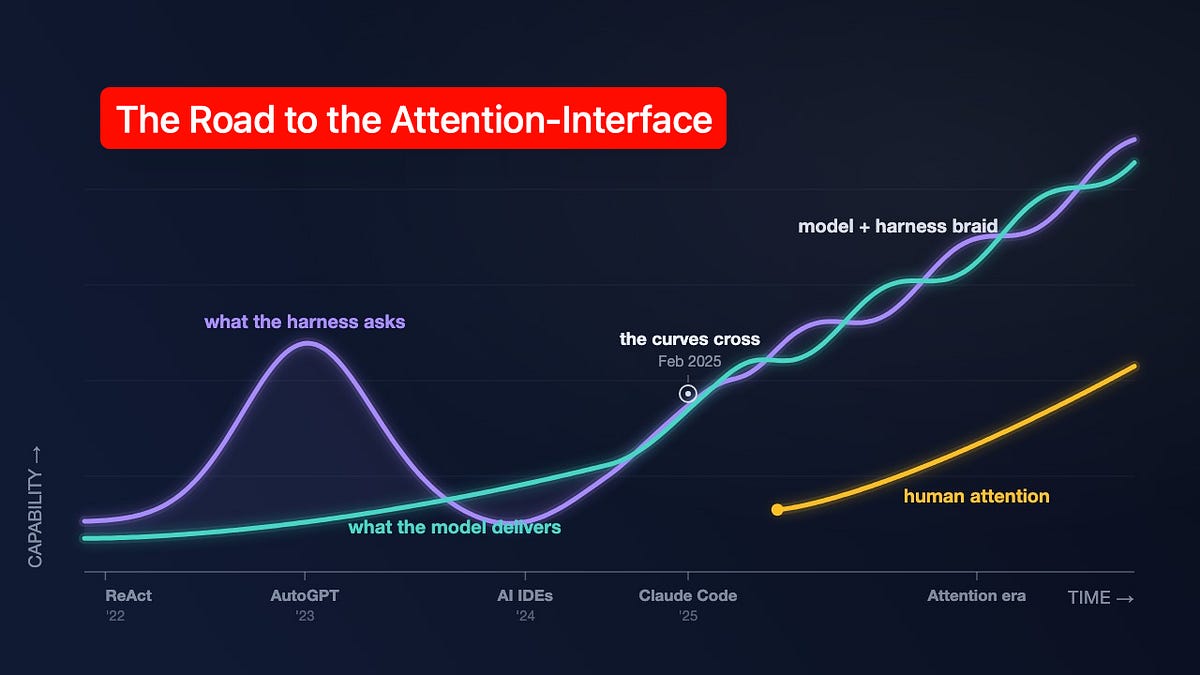
The shift of AI development is moving toward models absorbing the "harness"—the environment, tools, and guardrails surrounding model weights. This co-evolution reached a breakthrough with Anthropic's Claude Code in February 2025. By bypassing traditional IDEs for the terminal and utilizing permission rules, Claude Code allowed the model to run autonomously, driving the product to approximately $1 billion in annual recurring revenue within six months.
This success contrasts with earlier agentic attempts. In spring 2023, AutoGPT and BabyAGI struggled because a 95 percent per-step reliability over a 20-step task yielded only a 36 percent success rate. Similarly, early tests of Devin by Answer.AI showed a mere 15 percent success rate. Today, the harness itself dramatically impacts performance. On Harness-Bench, running the same model across 106 tasks using different harnesses produced a 23.8-point performance spread, with scores ranging from 52.4 to 76.2. Furthermore, adding retained reasoning and compaction to OpenAI's GPT-5.6 Sol on the ARC-AGI-3 benchmark tripled its score from 13.3 percent to 38.3 percent.
As reinforcement learning moves inside the harness—such as with OpenAI's codex-1, which was trained on real-world coding tasks—models are absorbing these external capabilities directly into their weights. This allows developers to radically simplify their codebases. For instance, Anthropic's Thariq Shihipar revealed that his team deleted 80 percent of Claude Code's system prompt because the underlying model had absorbed those functions.
For AI practitioners, this evolution shifts the engineering bottleneck. Instead of writing complex scaffolding, loops, and prompts, developers will focus on the interface between the autonomous agent and human attention. Future systems will rely on human attention policies to govern when an agent can autonomously execute decisions and when it must pause for human approval, transforming the harness into a tool for managing developer cognitive load.
This is our own summary of reporting by Latent Space