Pika Labs Debuts Pika Speech to Undercut ElevenLabs
Video-generation startup Pika Labs has launched Pika Speech, a highly efficient 3-billion-parameter text-to-speech model designed to dramatically lower the cost of real-time audio pipelines.
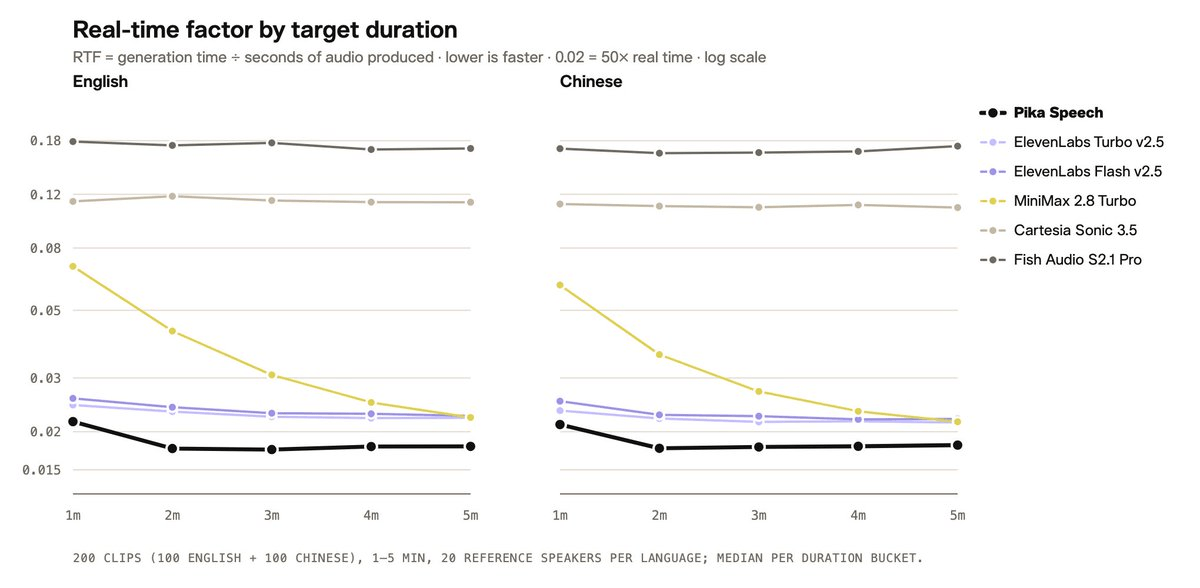
Pika Labs has introduced Pika Speech, a 3-billion-parameter flow-matching transformer model that produces studio-quality 48 kHz audio. Priced at just $0.01 per minute on the Pika API, the model is nine times cheaper than ElevenLabs v3, which costs $0.09 per minute. It is also 4.5 times more cost-efficient than Cartesia and ElevenLabs Turbo, and twice as cheap as Fish Audio, whose S2.1 Pro model costs $0.21 per minute. Pika Speech can clone voices using only five seconds of reference audio and supports both English and Chinese.
The model achieves a real-time factor of 0.02, generating one minute of speech in approximately 1.2 seconds (optimized down to 1.04 seconds from 1.29 seconds) for requests up to five minutes long. It was trained on 403,000 hours of filtered speech and distilled using distribution matching distillation to run in eight or fewer denoising steps. Instead of post-hoc stretching, Pika Speech uses an end-of-speech latent mechanism to control pace and duration internally. The serving stack leverages FlashAttention-3, token packing, a compiled full-precision vocoder, and CUDA graphs to minimize latency.
For developers, the model presents a clear trade-off between cost and cloning fidelity. In Pika's evaluations of 2,000 samples per language, Pika Speech recorded an English word error rate of 1.99% and a DNSMOS OVR of 3.188, matching top-tier models in perceptual quality. However, its Resemblyzer speaker similarity score of 80.30% trails competitors like MiniMax Speech 2.8 HD at 90.16% and Cartesia Sonic 3.5 at 87.41%. This makes Pika Speech highly viable for high-volume voice agents, dubbing, and long-form narration where cost is a barrier, though it may fall short if exact voice replication is critical. Additionally, Pika plans to use the model as low-latency audio infrastructure for its upcoming PikaStream 2.0 real-time video generator.
This is our own summary of reporting by AlphaSignal


