Google's New AI Framework Finds 66 Wearable Health Signals
Google Research has launched a multi-agent AI framework that discovered 66 new health biomarkers from wearable sensor data, outperforming existing scientific AI agents.
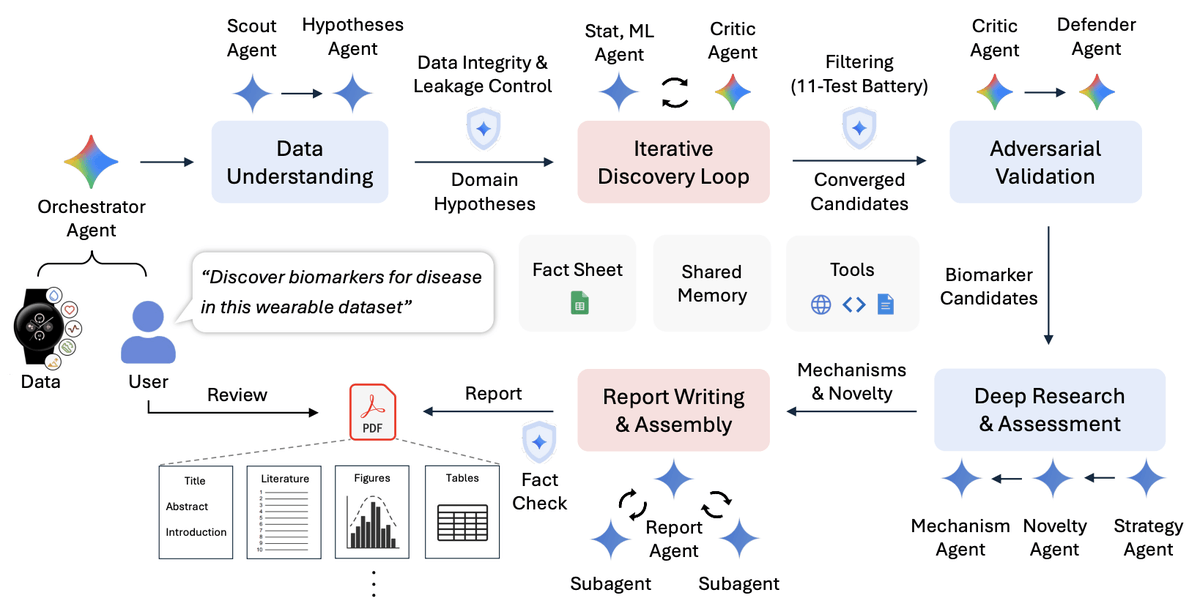
Google Research recently introduced the Biomarker Discovery Framework, a multi-agent system designed to extract reliable clinical insights from noisy wearable sensor data. To prevent common AI pitfalls like target leakage and overfitting, the system separates deterministic statistical computation from generative reasoning. It coordinates specialized agents—including Scout, Critic, Defender, and Mechanism—through a six-phase pipeline. This process is governed by an 11-check adversarial validation battery that assigns explicit reporting labels to flag unstable or weak candidate biomarkers.
Tested across three independent cohorts representing 9,279 participant-observations, the framework autonomously identified 41 mental health and 25 metabolic biomarker candidates. For metabolic health, it derived a cardiovascular fitness index by dividing steps by resting heart rate to correlate with insulin resistance. In depression analysis, it linked sleep-duration variability to PHQ-8 severity in the DWB cohort (ρ = 0.252, p < 0.001) and sleep-onset variability to PHQ-4 in the GLOBEM cohort (ρ = 0.126, p < 0.001; CV AUC = 0.535). Integrating these features improved predictive performance, yielding a ΔR² of 0.040 for depression and 0.021 for insulin resistance.
In a blinded evaluation by 15 experts in medicine and data science, the framework outperformed Google DeepMind's AI co-scientist, Biomni, and Google ADK's Data Science Agent. It was the only system to receive "Accept" or "Minor Revision" ratings, securing two accepts, eight minor revisions, eight major revisions, and three rejections. Reviewers estimated they would retain 56.9% of the framework's generated manuscript content, compared to just 18.8% to 30.4% for the baseline systems. It also ranked first in nine out of 13 four-system ranking sessions.
For practitioners, this architecture offers a blueprint for building reliable agentic workflows on messy, real-world time-series data. By forcing a structured debate between Critic and Defender agents and separating numerical execution from LLM reasoning, the framework ensures that statistical validity is treated as a core structural constraint rather than an afterthought. This prevents the generation of spurious correlations, turning raw telemetry into clinical hypotheses that human researchers can actually trust.
This is our own summary of reporting by AlphaSignal


%22%3E%0A%3Cstop%20offset%3D%220%25%22%20stop-color%3D%22%231a1c1c%22%2F%3E%3Cstop%20offset%3D%22100%25%22%20stop-color%3D%22%234c4546%22%2F%3E%0A%3C%2FlinearGradient%3E%3C%2Fdefs%3E%0A%3Crect%20width%3D%22800%22%20height%3D%22500%22%20fill%3D%22url(%23g)%22%2F%3E%0A%3Cg%20stroke%3D%22%23ffffff%22%20stroke-opacity%3D%220.10%22%20stroke-width%3D%222%22%3E%0A%3Cline%20x1%3D%22-200%22%20y1%3D%22500%22%20x2%3D%22100%22%20y2%3D%220%22%2F%3E%3Cline%20x1%3D%22-60%22%20y1%3D%22500%22%20x2%3D%22240%22%20y2%3D%220%22%2F%3E%3Cline%20x1%3D%2280%22%20y1%3D%22500%22%20x2%3D%22380%22%20y2%3D%220%22%2F%3E%3Cline%20x1%3D%22220%22%20y1%3D%22500%22%20x2%3D%22520%22%20y2%3D%220%22%2F%3E%3Cline%20x1%3D%22360%22%20y1%3D%22500%22%20x2%3D%22660%22%20y2%3D%220%22%2F%3E%3Cline%20x1%3D%22500%22%20y1%3D%22500%22%20x2%3D%22800%22%20y2%3D%220%22%2F%3E%3Cline%20x1%3D%22640%22%20y1%3D%22500%22%20x2%3D%22940%22%20y2%3D%220%22%2F%3E%3Cline%20x1%3D%22780%22%20y1%3D%22500%22%20x2%3D%221080%22%20y2%3D%220%22%2F%3E%0A%3C%2Fg%3E%0A%3Ctext%20x%3D%2248%22%20y%3D%22430%22%20font-family%3D%22Helvetica%2CArial%2Csans-serif%22%20font-size%3D%22132%22%20font-weight%3D%22800%22%0A%20fill%3D%22%23ffffff%22%20fill-opacity%3D%220.22%22%20letter-spacing%3D%22-4%22%3ETD%3C%2Ftext%3E%0A%3C%2Fsvg%3E)
