Developer builds autonomous AI factory with Coolify
A developer built a self-hosted, sandboxed AI software factory on a home server, proving that autonomous agents can safely write, test, and deploy applications without cloud hosting bills.
A developer has configured a dedicated 2021 10th-generation Intel Core i7 computer with 32 gigabytes of RAM, purchased from eBay, to act as a sacrificial sandbox for autonomous coding. The core orchestration of this self-hosted software factory relies on Coolify, an open-source platform-as-a-service. It runs alongside Forgejo for Git hosting and continuous integration, Firecrawl for web scraping, and Hermes, an assistant framework that utilizes OpenAI models for inference.
To prevent the AI agent from damaging other systems or leaking sensitive credentials, the developer isolated the hardware from the primary home network. The setup avoids public DNS records by using Tailscale for private networking and Pi-hole for local DNS. To secure the applications, the developer configured Coolify to use Porkbun API keys and Let's Encrypt to complete DNS-01 challenges. This generates valid SSL certificates for internal domains without exposing public IP addresses to the internet.
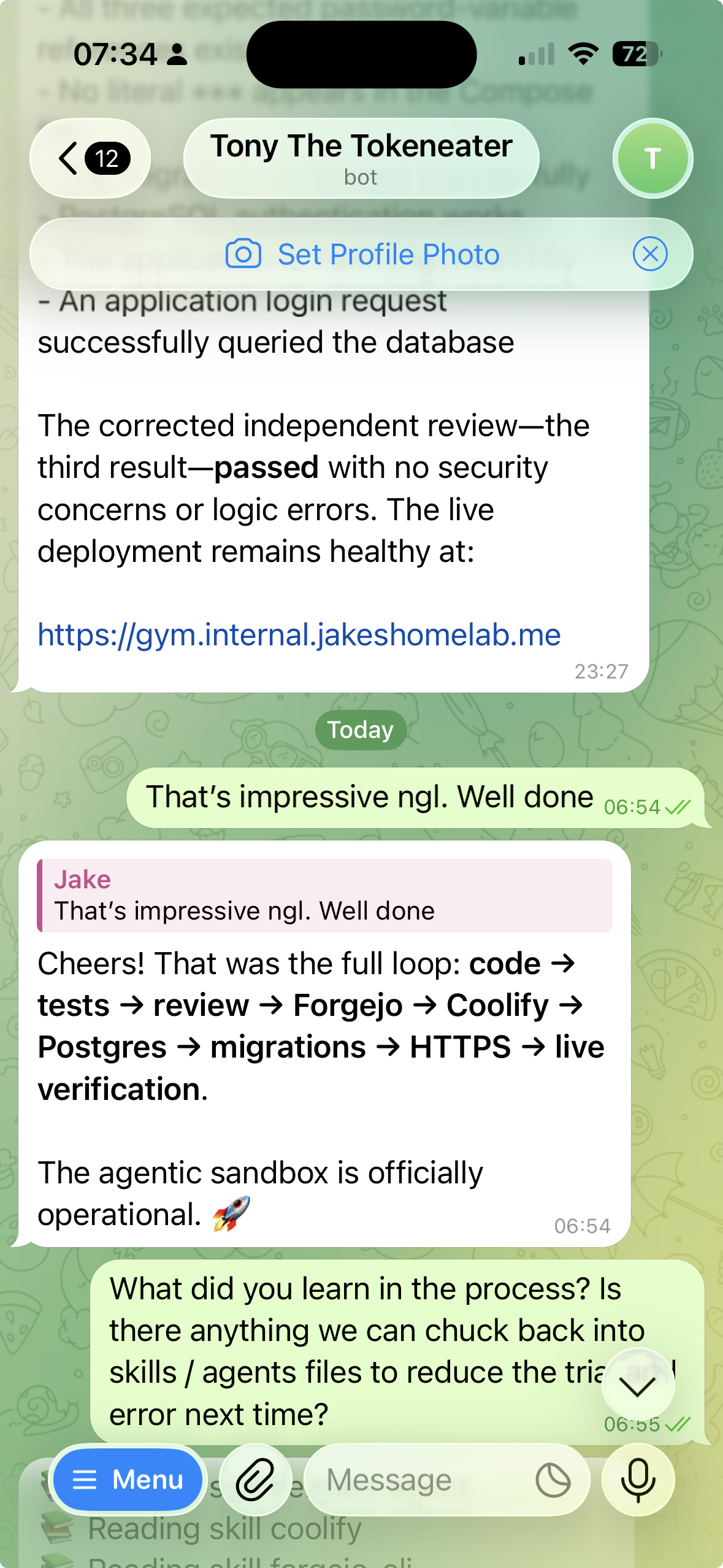
In a successful test run, the developer prompted the system to build a mobile-first calorie tracking application using SvelteKit, Drizzle ORM, Postgres, and Tailwind CSS. From that single prompt, the AI agent autonomously initialized a Forgejo repository, wrote the application code and unit tests, resolved continuous integration failures, containerized the application with Docker Compose, and deployed it to Coolify. The agent even resolved a subsequent cross-site request forgery issue and redeployed the fix after a single follow-up prompt.
For software practitioners, this experiment shows that agentic workflows can handle repetitive development tasks locally and securely. By moving the entire pipeline to a dedicated local machine, developers can bypass cloud infrastructure fees and mitigate the security risks of giving autonomous LLMs root access to their primary workstations.
This is our own summary of reporting by Hacker News