Artificial Analysis Arena Reveals Voice AI Trade-Offs
Artificial Analysis has launched the Speech Agent Arena, a blind preference benchmark revealing that the voice models humans enjoy talking to most are often the least reliable at completing tasks.
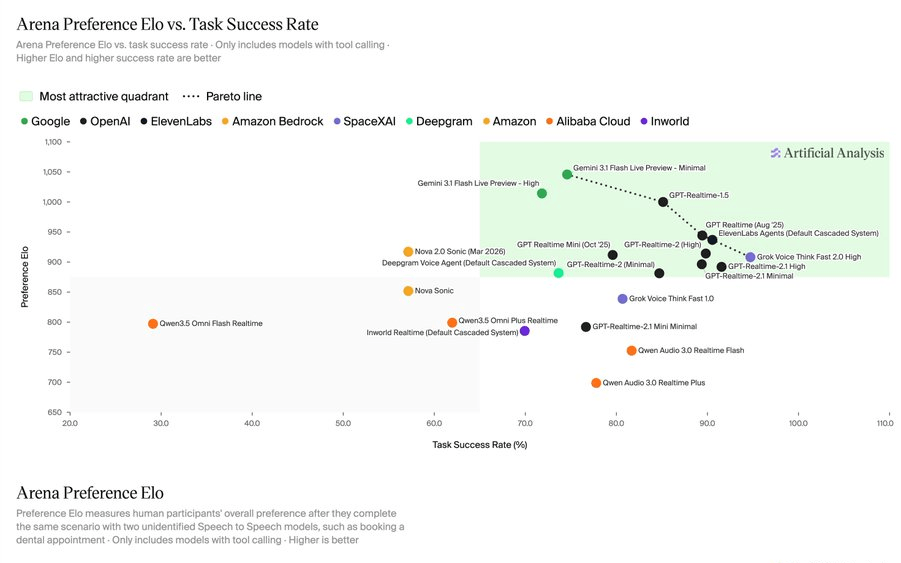
Artificial Analysis has introduced the Speech Agent Arena, a blind preference benchmark designed to evaluate native audio models across 35 real-world scenarios. These scenarios include 15 agentic tasks requiring tool calls, such as ordering pizzas under a $45 budget, and 20 non-agentic tasks focused on basic information exchange. The results have exposed a stark divergence between conversational charm and actual utility. The benchmark now replaces Conversational Dynamics in the Speech to Speech Index, holding a 25 percent weight alongside Speech Reasoning, tau-Voice agentic performance, and Task Success Rate.
The data shows that Gemini 3.1 Flash Live Preview - Minimal leads human preference with a 1046 Elo rating, yet it achieves only a 74.6 percent task success rate. Conversely, Grok Voice Think Fast 2.0 High tops task completion at 94.7 percent but ranks ninth in preference with a 908 Elo. Other tested models include GPT-Realtime-1.5, which serves as the anchor at 1000 Elo with an 85.1 percent success rate, and GPT-Realtime-2 High, which scored 914 Elo and an 89.8 percent success rate. GPT-Realtime-2.1 High reached an 892 Elo and 91.5 percent success rate, while the cascaded ElevenLabs Agents achieved a 937 Elo and 90.5 percent success rate.
Human preference closely tracks responsiveness, measured by Time to First Audio. Gemini 3.1 Flash Live Preview - Minimal responds in 0.96 seconds, GPT-Realtime-2 High takes 1.14 seconds, and the lower-ranked Qwen Audio 3.0 Realtime Plus lags at 1.54 seconds, landing at 699 Elo. Operating costs also vary widely, spanning from $1.50 per hour of input audio for the Gemini model to $4.80 for Grok and a steep $10.75 for GPT-Realtime-2.1 High.
For developers, these findings prove that automated benchmarks using synthetic users fail to capture real human experience. Because a model can sound polite while failing to execute a backend command, practitioners must treat task success as the primary metric for high-stakes applications like bookings or payments. Furthermore, the strong performance of cascaded systems like ElevenLabs shows that native audio models do not yet dominate the market by default.
This is our own summary of reporting by AlphaSignal


%22%3E%0A%3Cstop%20offset%3D%220%25%22%20stop-color%3D%22%231a1c1c%22%2F%3E%3Cstop%20offset%3D%22100%25%22%20stop-color%3D%22%234c4546%22%2F%3E%0A%3C%2FlinearGradient%3E%3C%2Fdefs%3E%0A%3Crect%20width%3D%22800%22%20height%3D%22500%22%20fill%3D%22url(%23g)%22%2F%3E%0A%3Cg%20stroke%3D%22%23ffffff%22%20stroke-opacity%3D%220.10%22%20stroke-width%3D%222%22%3E%0A%3Cline%20x1%3D%22-200%22%20y1%3D%22500%22%20x2%3D%22100%22%20y2%3D%220%22%2F%3E%3Cline%20x1%3D%22-60%22%20y1%3D%22500%22%20x2%3D%22240%22%20y2%3D%220%22%2F%3E%3Cline%20x1%3D%2280%22%20y1%3D%22500%22%20x2%3D%22380%22%20y2%3D%220%22%2F%3E%3Cline%20x1%3D%22220%22%20y1%3D%22500%22%20x2%3D%22520%22%20y2%3D%220%22%2F%3E%3Cline%20x1%3D%22360%22%20y1%3D%22500%22%20x2%3D%22660%22%20y2%3D%220%22%2F%3E%3Cline%20x1%3D%22500%22%20y1%3D%22500%22%20x2%3D%22800%22%20y2%3D%220%22%2F%3E%3Cline%20x1%3D%22640%22%20y1%3D%22500%22%20x2%3D%22940%22%20y2%3D%220%22%2F%3E%3Cline%20x1%3D%22780%22%20y1%3D%22500%22%20x2%3D%221080%22%20y2%3D%220%22%2F%3E%0A%3C%2Fg%3E%0A%3Ctext%20x%3D%2248%22%20y%3D%22430%22%20font-family%3D%22Helvetica%2CArial%2Csans-serif%22%20font-size%3D%22132%22%20font-weight%3D%22800%22%0A%20fill%3D%22%23ffffff%22%20fill-opacity%3D%220.22%22%20letter-spacing%3D%22-4%22%3ETD%3C%2Ftext%3E%0A%3C%2Fsvg%3E)
